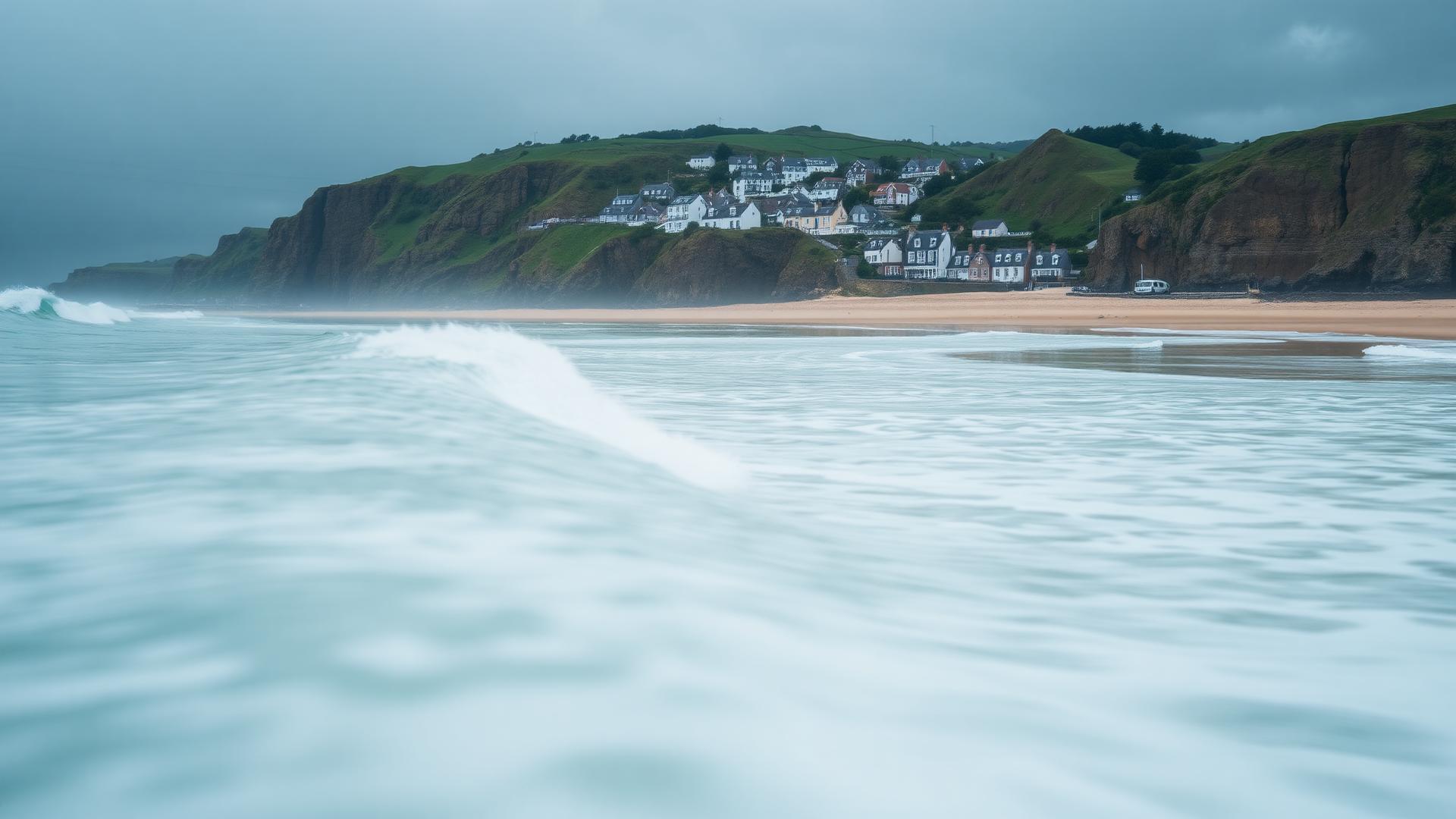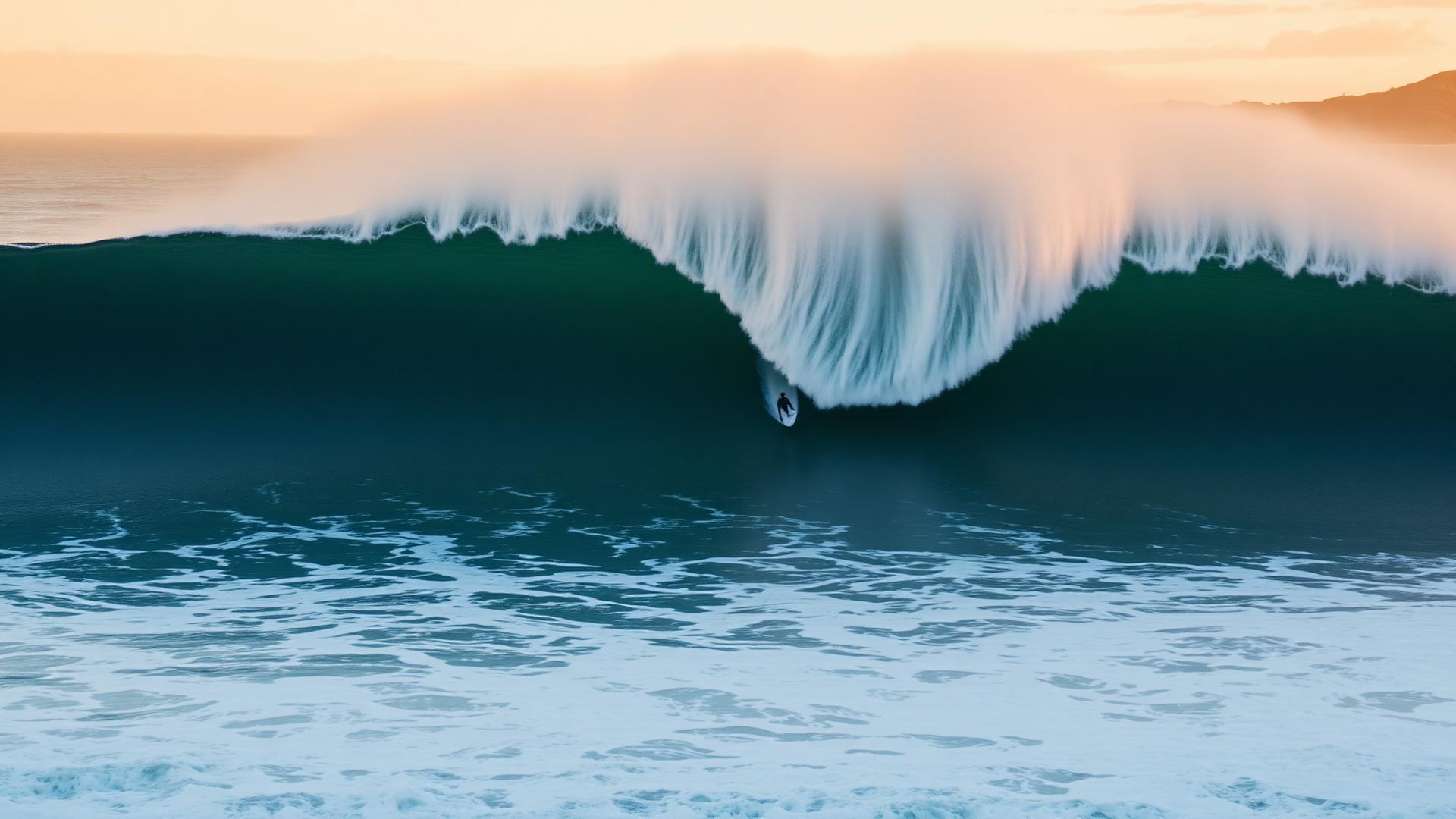
There is a stretch of Portuguese coastline where the Atlantic Ocean stops behaving like an ocean and starts behaving like a weapon.
Praia do Norte, just below the lighthouse at Nazaré, is where surfers now come to find out whether they can survive walls of water taller than a six-story building. What makes this stretch of sand different from every other big-wave break on the planet is not luck or exposure alone — it is a 230-kilometer submarine canyon lying directly offshore, funneling open-ocean swell energy into the beach with almost no loss of power. Since 2011, that geological accident has rewritten the record books of surfing.
This is the story of how a sleepy fishing village of drying cod and hand-painted boats turned into the undisputed capital of big-wave riding — and what you need to know if you want to see it in person.
The Canyon: Nature's Wave Amplifier
The Nazaré Canyon is the largest submarine canyon in Europe, plunging to depths of roughly 16,000 feet (about 5,000 meters) at its deepest point, right off a coastline where the continental shelf elsewhere is shallow and gentle. Deep-ocean swells that would normally lose energy dragging across a shallow shelf instead travel down this trench largely undisturbed, refracting and converging as the canyon narrows near shore.
The result is a bathymetric funnel effect: swell energy from distant North Atlantic storms gets focused and stacked directly onto Praia do Norte, while a shallower sandbank just north forces the incoming waves to jack up violently rather than spill out gradually. Add a beach oriented to catch north and northwest winter groundswells, and you get a wave that can realistically reach 60, 80, even close to 100 feet on the biggest days — a scale that exists almost nowhere else that is also accessible from land.
From Fishing Village to Guinness World Record
Local fishermen had feared these waters for centuries, well aware that Nazaré's coast could turn from flat to furious within hours; a German U-boat and numerous fishing vessels lie wrecked in the canyon's depths. But nobody thought to surf it until 2005, when local bodyboarder Dino Casimiro began filming enormous, unridden swells breaking at Praia do Norte and started reaching out to the international big-wave community to prove what he was seeing was real.
The turning point came in 2010, when Hawaiian big-wave surfer Garrett McNamara partnered with local surfer Andrew Cotton and the Nazaré municipality to test the wave using jet-ski tow-in assistance. On November 1, 2011, McNamara rode a wave measured at 78 feet (23.77 meters), a ride that was certified by Guinness World Records as the largest wave ever surfed. Overnight, a town best known for its dried fish and traditional seven-skirt costumes became a household name in extreme sports.
The record has kept falling ever since. Brazilian surfer Rodrigo Koxa broke McNamara's mark in 2017 with a ride estimated at 80 feet (24.38 meters), still recognized as the largest wave ever surfed by a man. On the women's side, Brazilian Maya Gabeira set the current record in 2020 with a wave of roughly 73.5 feet (22.4 meters) — a comeback story in itself, since Gabeira had nearly drowned at the same break in 2013 and needed years of recovery before returning to reclaim the record. German surfer Sebastian Steudtner has also chased and claimed unofficial measurements north of 90 feet at Nazaré, keeping the ceiling of what is physically possible constantly in question.
The Tow-In Safety Revolution
Waves of this size cannot be paddled into; by the time a surfer could catch one under their own power, it would already be breaking on top of them. Nazaré is ridden almost exclusively via tow-in surfing, where a jet-ski driver whips the surfer into the wave using a tow rope, letting them reach the speed needed to drop in well before the lip throws.
That speed requirement created an entire safety industry around the wave. Riders now wear inflatable impact vests that can be triggered manually to bring an unconscious or injured surfer to the surface after a wipeout, alongside reinforced helmets and wetsuits built to survive being dragged across the reef and sandbar below. Jet-ski rescue teams — often multiple skis working in coordinated rotation — sit just outside the impact zone specifically to snatch surfers out of the water within seconds of a fall, since a hold-down under a wave this size can last well over a minute and stack multiple waves on top of a downed rider.
This infrastructure, refined at Nazaré over more than a decade, has since become the template copied at every serious big-wave venue in the world, from Mavericks in California to Jaws in Maui. In a very real sense, Nazaré did not just produce bigger waves — it produced the safety systems that made riding them survivable.
The WSL Nazaré Tow Surfing Challenge
The World Surf League now runs the Nazaré Tow Surfing Challenge as part of its Big Wave Tour, a waiting-period event that only runs when forecasters flag a swell big enough to justify calling competitors in from around the globe. Unlike a conventional heat-based contest, riders are judged on individually scored waves across the whole swell window, with points awarded for wave size, commitment, and the line taken on the face.
The event has become appointment viewing for surf fans well beyond the usual competitive tour audience, largely because the stakes are visible in real time: a botched wipeout at Nazaré is not a lost heat, it is a genuine medical emergency unfolding live on a webcast watched by hundreds of thousands of people. That tension, more than any scoring system, is what has made Nazaré into surfing's most dramatic stage.
A Fishing Town Transformed
Nazaré's tourism numbers have roughly tripled since the McNamara ride put the town on the map, and on major swell days more than 150,000 spectators have been recorded lining the cliffs and lighthouse above Praia do Norte to watch. Hotels and restaurants that once relied entirely on the summer beach season now do steady business through the winter big-wave months, and the town has built out museum space at the Forte de São Miguel lighthouse dedicated to the boards, wetsuits, and photographs behind the records.
- Traffic and parking around the headland become genuinely difficult on forecasted big-swell days
- Local fishing fleets have voiced concern about pressure on traditional harbor space and identity
- Real estate and rental prices near the seafront have risen sharply since 2011
- Some residents describe an uneasy mix of pride in the global attention and discomfort with what critics call a spectacle economy built around real physical danger
How to Visit: A Spectator's Guide
Nazaré is roughly 75 minutes north of Lisbon Airport by car or bus, making it an easy day trip or overnight stay for travelers already in Portugal. The best window for a genuine chance at witnessing giant surf runs from October through March, when North Atlantic storms generate the deep-water groundswells the canyon needs; summer months are calmer and better suited to the town's regular beach and boardwalk life.
- Base yourself in Nazaré town or nearby Sítio, the clifftop neighborhood right above Praia do Norte
- Head straight to the Farol da Nazaré (Nazaré lighthouse) and Forte de São Miguel — the single best free vantage point over the wave, with a small museum on site
- Check a reliable swell forecast (buoy data and long-range charts) a few days ahead; big days are announced, not spontaneous
- Dress for wind — the clifftop is exposed and can be far colder than the town below, even in mild weather
- Respect barriers and closed sections of the cliff path on the biggest days; waves have swept spectators off the rocks in past seasons
- Time your visit around a forecasted swell window rather than fixed dates, since the giant days depend entirely on the ocean's schedule
Watching from the cliff, what strikes most visitors is not just the size of the waves but the silence beforehand — the long lull as everyone waits, binoculars raised, for the horizon to darken and rise. Then the wave arrives, a jet ski disappears into a streak of white spray chasing a single rider down a moving wall of water, and for a few seconds an entire cliffside of strangers holds its breath together.
Nazaré doesn't ask if you're ready. It shows you immediately whether you are.
GALLERY
REFERENCES
- Nazaré Waves - Nazaré North Canyon
- World Surf League - Nazaré Tow Surfing Challenge
- Red Bull - The History of Big-Wave Surfing at Nazaré
- Surfer Today - How to Successfully Ride a Big Wave in Nazaré
- The Inertia - Nazaré Big Wave Coverage
- Encyclopedia of Surfing - Nazaré
- Wikipedia - Nazaré Canyon; Garrett McNamara; Maya Gabeira; Rodrigo Koxa
- Câmara Municipal de Mafra - Nazaré Tourism